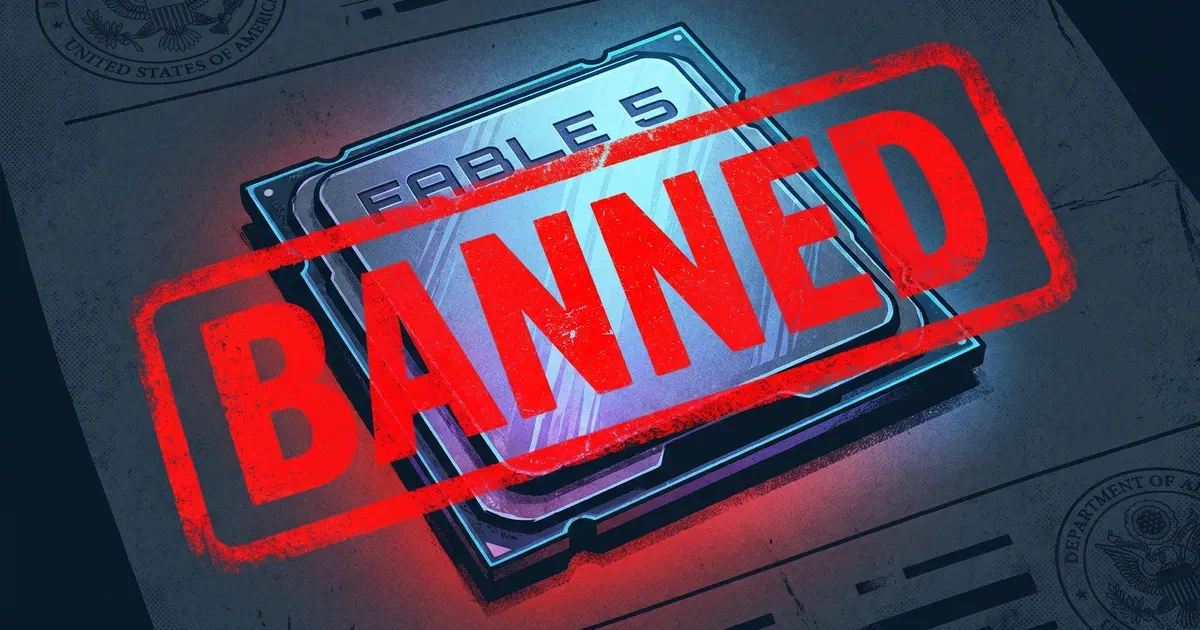

In June 2026, a frontier AI model was switched off for every customer at once — by government order. Anthropic disabled Fable 5 and Mythos 5 across its entire customer base to comply with a US export-control directive issued under national-security authority.
If your product runs on a specific model, sit with that for a second. The dependency at the center of your system is revocable — by people who are not your vendor, do not answer to your SLA, and were not in the room when you designed your architecture.
I want to talk about what that means for the people who have to keep these systems running. Not whether the order was justified. Whether you have a plan for the day your model disappears. Most teams don’t, because model choice gets treated as a static design decision instead of a continuity risk. After June, that’s no longer defensible.
What actually happened#
The US government invoked export-control and national-security authority to bar foreign-national access to Fable 5 and Mythos 5 — by any foreign national inside or outside the US, including foreign nationals employed at Anthropic itself. To comply with a ban that broad, Anthropic couldn’t simply geofence a few accounts; it said the order effectively forced it to disable both models for all customers.
The stated trigger was a jailbreak. By Anthropic’s own account, the government believed it had found a method of bypassing Fable 5 — but Anthropic says it was handed only verbal evidence, and that the underlying vulnerabilities were minor, previously known, and reproducible with other publicly available models. I’m not going to adjudicate that dispute, and you shouldn’t have to either. Both readings are on the record; pick neither for the purpose of this discussion.
There’s a fair amount of reporting that the jailbreak was never really the point — that the move sits inside a longer-running fight between Anthropic and the administration, including the Pentagon having previously labeled the company a supply-chain risk. I raise it only because it sharpens the real lesson: model availability is now contingent on politics, not just uptime. That’s the part that lands on your desk.
A recall is not an outage#
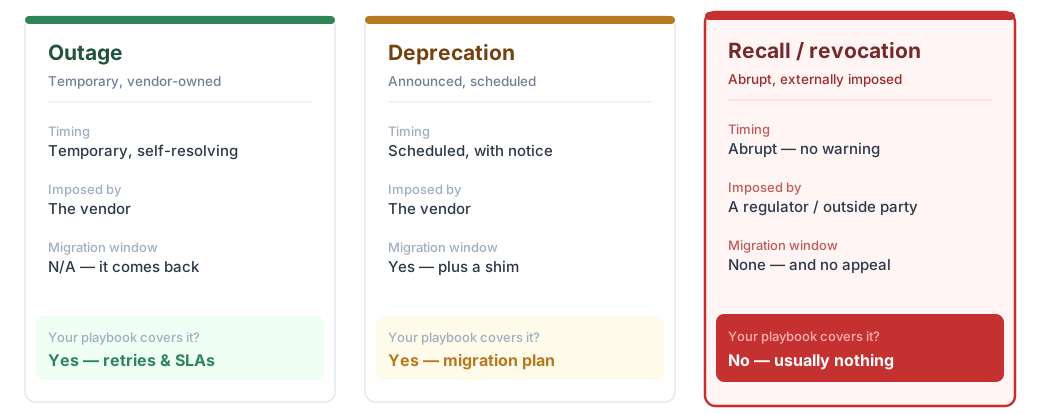
We already plan for vendor downtime. We have retries, fallbacks, status pages, and SLAs with credits attached. A model recall is a different animal, and the playbooks you already wrote don’t cover it.
Walk the failure modes:
- Outage — temporary, owned by the vendor, resolves on its own. Your retry logic handles it.
- Deprecation — announced ahead of time, scheduled, with a migration window and usually a compatibility shim.
- Recall or revocation — abrupt, imposed from outside the vendor relationship, potentially permanent, with no migration window and no appeal you control.
The new variable is that a model’s availability now carries an attribute that looks a lot like a license: its export-control status. That status can change without your vendor wanting it to, and a change can reach into things you thought were settled — where your data lives, who on your team is allowed to touch the system, whether a foreign national on your staff is now a compliance trigger rather than a teammate.
You can’t forecast the politics. You don’t need to. The risk-based move is entirely in your control: make sure no single revocable model is a single point of failure for a system you’re obligated to keep running. That’s the 20% of this problem that buys you 80% of the protection.
Why this breaks federal authorization#
If you work in federal systems, there’s more. An externally forced model disappearance doesn’t just degrade a feature. It can invalidate the assumptions your Authority to Operate rests on.
Saying it plainly: an export-control order can invalidate an ATO. The capability you got authorized was assessed against a specific model with specific behavior. Revoke that model and swap in another to stay operational, and you are no longer running the system that was assessed. The paperwork describes something that no longer exists.
It touches controls you already answer for:
- Contingency planning. Is there a documented, tested fallback for the authorized model becoming unavailable? Most AI system security plans I’ve seen treat the model as a stable given. It isn’t one anymore.
- System boundary and the SSP. The model usually shows up as an external service inside the boundary. A forced revocation changes the boundary with no change request and no warning.
- Supply-chain risk management. Model provenance and availability belong here, but export-control exposure is almost never enumerated as a supply-chain risk in the assessments I’ve read.
- Configuration and authorized baselines. Switching models to keep the lights on is, formally, a change to an authorized component. You don’t get to skip that because the change was forced on you.
None of this means the risk is unmanageable. It means the SSP, the contingency plan, and the POA&M need to say out loud that the model is a controlled, potentially revocable component — and what happens when it goes away. The goal isn’t to eliminate the risk. It’s to not be the team caught with zero fallback for a system that has to stay up.
Design for model portability#
The technical mitigation isn’t exotic. It’s the same discipline that protects you from lock-in generally, done on purpose instead of by accident.
Put an abstraction layer between your product and the provider. Don’t call a single vendor’s SDK directly from product code. Route through a model-agnostic layer so that repointing to a fallback is a config change, not a refactor. I’ve written before about using LiteLLM as that seam for supply-chain reasons; the continuity argument is the same seam, different motivation.
Build an eval harness, and treat it as the single most useful thing on this list. The reason teams can’t swap models quickly isn’t the routing — it’s that they have no way to know the swap is safe. A maintained eval set built from your actual tasks (not a public leaderboard) turns “switch models” from a multi-week revalidation into a graded decision you can defend in front of an assessor. If you do one thing after reading this, build the evals.
Keep a tiered fallback. A primary model, a secondary from a different vendor, and a documented degraded mode — a smaller, older, or self-hosted model that keeps the critical path alive even if quality drops. For the self-hosted tier, the same hardening that applies to any local model deployment applies here; the point is that “degraded but running” beats “authorized but dark.”
Specify capability, not model identity. Write your requirements in terms of thresholds your evals enforce — “passes these forty checks at this latency” — rather than “must be Model X.” Any model that clears the bar is acceptable, and your spec stops being a hostage to one vendor’s roadmap or one government’s export list.
The anti-pattern is the thing most codebases already do: a model name hard-coded in thirty places, prompts tuned so tightly to one model’s quirks that they don’t survive a swap, and “we’ll switch if we have to” written down nowhere as an actual procedure. Portability has real overhead, so tier it. The systems that must survive a recall get the full treatment. The rest get a documented manual-swap runbook and an honest note that recovery will take days.
Put it on the risk register#
This is a governance gap as much as an engineering one, and the governance fix is cheap relative to the exposure.
Most AI risk registers track how a model behaves — bias, hallucination, jailbreak. Very few track whether the model will be there tomorrow. Add model-availability risk as its own line item, and give it real entries:
- Concentration risk — what fraction of your critical AI workloads ride a single model from a single vendor? If it’s most of them, that’s the finding.
- Export-control and sanctions exposure — foreign-national access on your team, data residency, and the vendor’s own regulatory standing all feed this.
- Contractual continuity — does your vendor contract say anything about a regulator forcing discontinuation? It almost certainly doesn’t. Flag the omission.
- Policy monitoring — name the person responsible for noticing an export action before it forces a 2 a.m. scramble. If no one owns it, no one is watching.
That register entry is also what makes your contingency plan and your SSP language defensible when an assessor asks the obvious question.
The free fire drill#
The Fable 5 ban is a fire drill you didn’t have to schedule. Treat it like one.
The shift is simple to state: model availability has joined latency, cost, and accuracy as a first-class property you design and govern around. The action is just as simple. Pick your most critical AI-dependent system and answer one question this week — if its model were revoked tomorrow, what is the documented, tested fallback? If the answer is silence, you just found your next sprint.
You can’t control the policy. You can control whether a single revocable model is allowed to be a single point of failure. That part was always yours.
— Ender