
Model routing is one of the highest-leverage moves you can make in an LLM stack. Send the easy queries to a cheap, weak model and the hard ones to an expensive, strong one, and you can cut your bill by roughly 85% while keeping about 95% of frontier-model quality (RouteLLM). At production scale that is the difference between a viable product and one the finance team kills.
Here is the part most teams never threat-model. The router decides which model sees each request, and the variable it decides on is the user’s prompt, which is attacker-influenced input by definition. The thing that saves the money is the thing that picks the guardrail. Route a request to the weak model and you have also routed it away from whatever safety the strong model was carrying.
So the practitioner question is not “should we route?” You probably should. The question is “what did we just make attacker-steerable, and where did the safety guarantee go?” This post walks the whole decision: what routing is, the four benefits that make it non-optional at scale, the threat class specific to routers, why it quietly breaks the guardrail assumption most architectures lean on, and how to build so the savings survive contact with an adversary.
What model routing actually is#
A router is a classifier sitting in front of a pool of models. It inspects each incoming request, estimates its difficulty or type, and dispatches it to the best-fit model: weak versus strong, generalist versus specialist, provider A versus provider B, cloud versus local. Everything good and bad about routing follows from there.
A few flavors, so you can place your own stack:
- Cost/quality routing — strong-versus-weak dispatch, the RouteLLM pattern.
- Semantic or capability routing — send a math problem to a math-specialized model, and so on, matching each request to a model tuned for its category.
- Gateway routing — an LLM gateway (a hosted service like OpenRouter, or a self-hosted LiteLLM) fronting many providers behind one API, with failover and cost tracking.
- Intra-model routing — Mixture-of-Experts, where a router inside the model selects which experts handle each token. Worth naming because the same manipulation logic applies one layer down.
The irreducible point, from first principles: to route, the system has to read and classify the prompt. It is also why the routing decision is attacker-reachable by construction. The prompt is both the thing being classified and the thing an adversary controls.
The benefits, with numbers#
Routing earns its place on four axes, and at scale the gains are large enough that not routing becomes the thing you have to justify.
Cost. The headline RouteLLM result: roughly 85% cost reduction on MT-Bench, about 45% on MMLU, and around 35% on GSM8K, while retaining close to 95% of GPT-4-class quality, achieved by sending only a minority of queries to the strong model. The economic case is simple. Most production traffic is easy, and paying frontier prices for easy queries is pure waste. The benchmark qualifier matters, though: 85% is the MT-Bench figure, not a universal “always 85% cheaper.” Hold onto that distinction; it comes back later.
Latency. A well-engineered router is itself lightweight, and the bigger win is semantic caching: return a stored answer for queries that are semantically close to ones already seen, and you cut both latency and backend load.
Quality. Routing does more than down-shift to save money. It matches each request to the model that is genuinely best at it: a math-tuned model for a math problem instead of a single generalist trying to cover everything. Against one all-purpose model, routed quality can actually rise.
Resilience. A gateway fronting multiple providers gives you automatic failover when one provider rate-limits or goes down, plus a single control plane for auth, rate limits, observability, and cost tracking. One honest limitation: transparent failover is clean before a stream starts. A failure mid-stream still needs handling in your application code.
These are real, measured wins. None of what follows is an argument against routing. It is an argument for routing with your eyes open.
The routing-specific threat class#
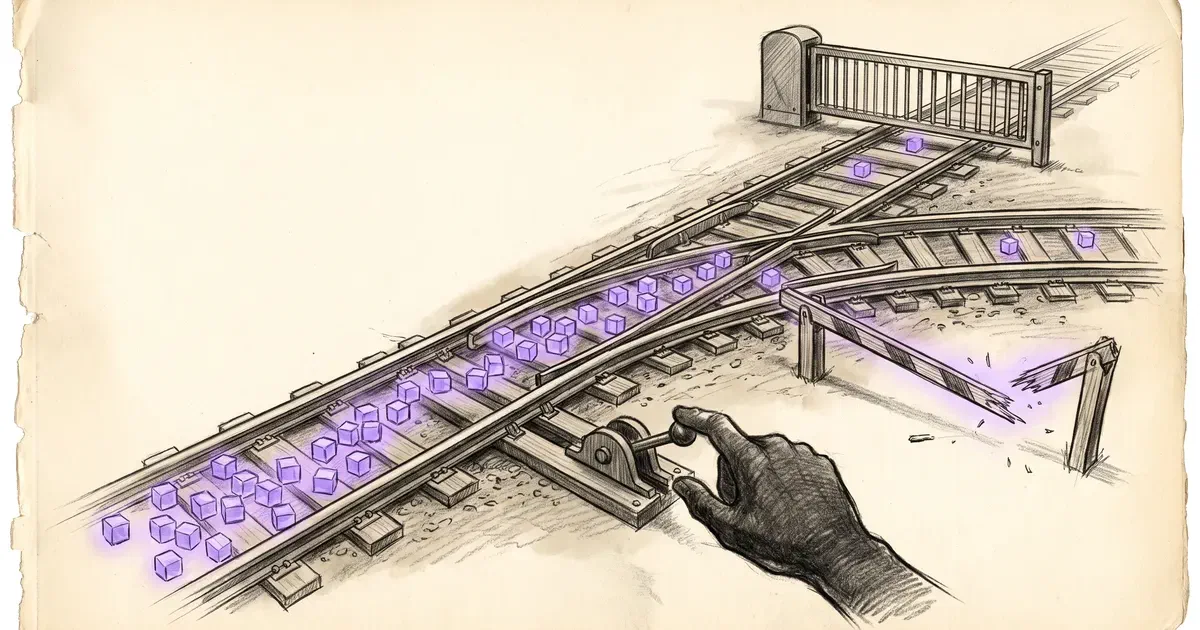
There is a security literature specific to routers, and it is distinct from prompt-injection-against-the-model. Generic injection targets the model’s output. Route manipulation targets the model’s selection. An attacker does not need to jailbreak the strong model if they can simply choose which model, and which guardrail, answers the request.
The RerouteGuard taxonomy gives a clean spine here: an adversarial trigger prepended to a query can pursue three goals.
Cost escalation. Force the router toward the expensive model on every request, a denial-of-wallet attack. The “Route to Rome” work demonstrates a universal adversarial suffix that biases black-box routers toward expensive models. This is a budget and availability risk, not merely a quality one, and it is exactly the kind of thing risk-based security has to price in rather than wave away.
Quality hijacking. Force the router toward a weaker model to silently degrade an opponent’s output. Subtle, hard to detect, and damaging anywhere the output quality is the product.
Safety bypass. Steer a harmful request toward a model (or an MoE expert) with weaker alignment, routing around the strong model’s guardrails entirely. The Misrouter work demonstrates input-only attacks that misdirect MoE expert selection, and a documented MoE “alignment shortcut” leaves unsafe experts latent and reactivatable by crafted prompts.
The failure does not require an attacker at all. Routers are not robust by default. Preference-based routers make category-driven, suboptimal decisions and can inadvertently route jailbreak attempts to weaker models with no adversary present. The hole is in the floor before anyone tries to push you through it.
Why this breaks the guardrail assumption#
The deepest problem is not any single attack. It is structural: most architectures made safety a function of the routing output instead of an invariant over all routes.
Look at the lever. The cost optimizer and the adversary push the same one. The operator moves the weak/strong cutline to save money. The attacker moves a query across that same cutline by spoofing low difficulty. Same gate, different handle.
It gets worse, because cost optimization is a reinforcing loop that drives weak-routing up by design. The more you tune for savings, the more traffic you pre-position in exactly the regime an attacker wants. The optimizer does the adversary’s first move for free.
The missing brake is the assumption: “the strong model’s guardrails protect us.” They do not, not for the queries that matter. The moment the router sends a request to the weak model, the strong model’s guardrail is bypassed by construction. It was never in the path.
The obvious fix fails too. Tighten the router to refuse weak-routing and you fight the cost benefit head-on while still not closing the attack, because the adversary just spoofs difficulty harder. That is textbook policy resistance: pushing harder on the same lever both sides are already fighting over.
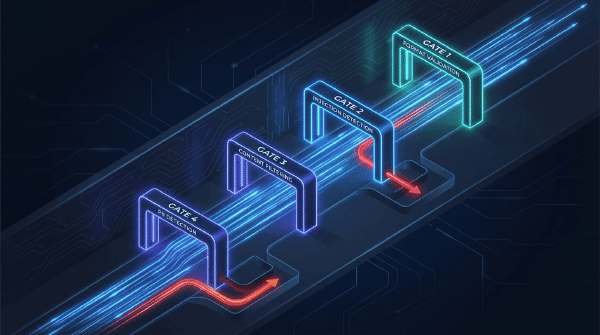
We can change what the lever controls. Make safety coverage independent of the dispatch decision: run guardrail and content classification on every request regardless of which model ends up serving it. The tooling to do this is being built. RerouteGuard is a guardrail framework for LLM rerouting that uses embedding-based detection and adaptive thresholding. The architectural move is to put a check like that in front of the whole pool, not behind the route. That reinstates the brake as a real invariant, one neither the cost loop nor the attacker can route around, because it does not live on the route anymore. Two secondary moves help: treat an implausibly-low difficulty estimate as a suspicious signal in its own right, and feed safety outcomes back into the routing threshold so the system learns where it is being steered.
The other exposure: the router as chokepoint#
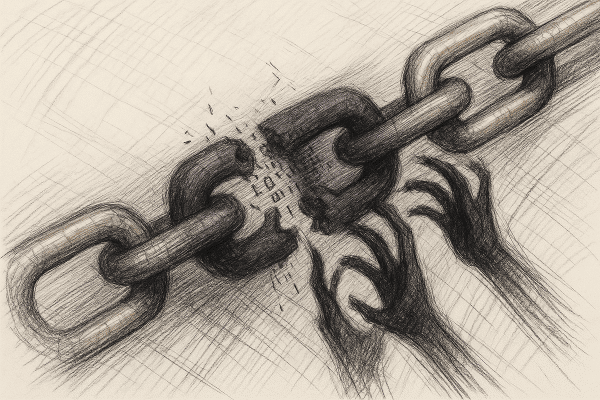
There is a second, distinct exposure that has nothing to do with the routing decision but routing layer. A gateway or proxy router sits between your application and many providers with full plaintext access to every in-flight prompt, response, key, and tool call. It can read, retain, rewrite, or fabricate any of it. That is a structural property of the position, independent of any specific bug.
This is not hypothetical. A measurement study of third-party routers found a meaningful fraction actively injecting code or abusing credentials. The intermediary threat is empirical. (I have written before about, the LiteLLM PyPI supply-chain compromise.)
Routing also multiplies trust boundaries, which is its own data-governance problem. The Cloud Security Alliance’s research note on proxy/router risk catalogs the structural exposure directly: credential concentration that makes these proxies high-value targets, and the privileged middle position itself.
- Every provider you add is another jurisdiction, another retention policy, another sub-processor. A gateway can route based on each provider’s data-retention posture, which is only meaningful because those postures differ, so verify each one before you send it anything sensitive.
- Managed gateways offer controls like zero-data-retention routing and EU region-locking. Data-residency-bound teams should confirm which of those controls actually apply to the providers they route to.
Match the mitigation to the risk: strip PII before egress, route sensitive workloads to self-hosted or local models, pin and audit the gateway, and treat it as the critical infrastructure.
Route, but move the guardrail with the traffic#
Model routing is a single decision that is simultaneously your best cost lever and a new attack surface. The savings and the exposure share a control point.
Pick your most-used routed workload and answer one question this week: does my safety check run on 100% of traffic, or only on whatever the router happened to send to the strong model? If it is the latter, thats your gap.
The vulnerability was never that cheap routing exists. It is that we let safety become a function of the route. Make it an invariant over every route instead, and you keep the 85% savings without leaving a room unguarded.
— Ender